歯科医師、特に矯正医向けの最新矯正論文情報サイト
日常診療で多忙な歯列矯正医のためのドクター専用サイトです。
日々の診療や臨床、医学研究に役立つ最新海外論文をPubMedから情報を提供します。
Evidence-Based Medicine (EBM)、すなわち、科学的根拠に基づいた医療情報を提供します。
アブストラクトだけでなく、結果の表やグラフなど詳しい情報を日本語に訳して提供しています。
今回は、2025年International Journal of Oral Scienceに投稿された論文の紹介です。
是非最後までご覧いただき、お忙しい先生方の情報収集にお役立てください。
*今回はGoogle NotebookLMを用いてスライドを作成いたしました。
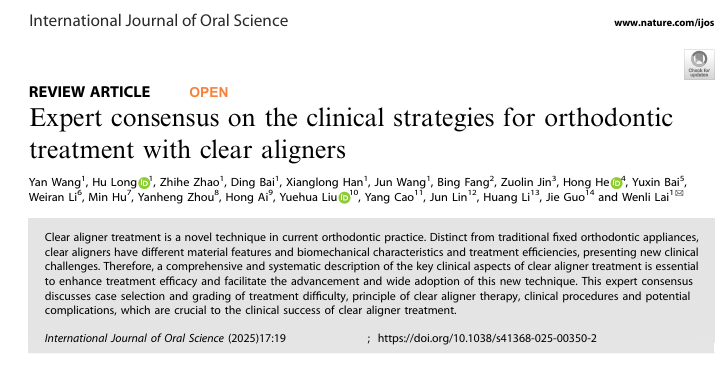
題目・著者
【題目】
Expert consensus on the clinical strategies for orthodontic
treatment with clear aligners
【著者】
Yan Wang1, Hu Long1, Zhihe Zhao1, Ding Bai1, Xianglong Han1, Jun Wang1, Bing Fang2, Zuolin Jin3, Hong He Weiran Li6, Min Hu7, Yanheng Zhou8, Hong Ai9, Yuehua Liu4, Yuxin Bai5,10, Yang Cao11, Jun Lin12, Huang Li13, Jie Guo14 and Wenli Lai1✉
1:State Key Laboratory of Oral Diseases & National Center for Stomatology & National Clinical Research Center for Oral Diseases & Department of orthodontics, West China Hospital of Stomatology, Sichuan University, Chengdu, China;
2:Department of Orthodontics, Ninth People’s Hospital Affiliated to School of Medicine, Shanghai Jiaotong University, Shanghai, China;
3:School of Stomatology, Department of Orthodontics, The Fourth Military Medical University, Xi’an, China;
4:State Key Laboratory of Oral & Maxillofacial Reconstruction and Regeneration, Key Laboratory of Oral Biomedicine Ministry of Education, Hubei Key Laboratory of Stomatology, School & Hospital of Stomatology, Wuhan University, Wuhan, China;
5:Department of Orthodontics, Beijing Stomatological Hospital, School of Stomatology, Capital Medical University, Beijing, China;
6:Department of Orthodontics, Peking University School and Hospital of Stomatology & National Center for Stomatology & National Clinical Research Center for Oral Diseases & National Engineering Research Center of Oral Biomaterials and Digital Medical Devices & Beijing Key Laboratory of Digital Stomatology & NHC Key Laboratory of Digital Stomatology & NMPA Key Laboratory for Dental Materials, Beijing, China;
7:Department of Orthodontics, School and Hospital of Stomatology, Jilin University, Changchun, China;
8:Beijing Tsinghua Changgung Hospital, School of Clinical Medicine, Tsinghua University, Beijing, China;
9:Department of Stomatology, The Third Affiliated Hospital of Sun Yat-sen
University, Guangzhou, China;
10:Department of Orthodontics, Shanghai Stomatological Hospital & School of Stomatology, Shanghai Key Laboratory of Craniomaxillofacial
Development and Diseases, Fudan University, Shanghai, China;
11:Hospital of Stomatology, Guanghua School of Stomatology, Sun Yat-sen University, Guangdong Provincial Key Laboratory of Stomatology, Guangzhou, China;
12:Department of Stomatology, The First Affiliated Hospital, College of Medicine, Zhejiang University, Hangzhou, China;
13:Nanjing Stomatological Hospital, Affiliated Hospital of Medical School, Nanjing University, Nanjing, China
14:Department of Orthodontics, School and Hospital of Stomatology,
Shandong University & Shandong Key Laboratory of Oral Tissue Regeneration & Shandong Engineering Laboratory for Dental Materials and Oral Tissue Regeneration & Shandong Provincial Clinical Research Center for Oral Diseases, Jinan, China
Correspondence: Wenli Lai (wenlilai@scu.edu.cn)
概要
本論文は、2025年に発表された「クリアアライナー矯正治療の臨床戦略に関する専門家コンセンサス」に基づき、その主要なテーマとガイドラインをまとめたものである。
クリアアライナー矯正治療は、従来の固定式装置とは異なる材料特性とバイオメカニクスをもち、審美性、快適性、口腔衛生の維持において優位性がある一方、症例選択や治療計画、モニタリングにおいて特有の課題を提示している。
治療の成功の鍵は、正確な難易度評価、バイオメカニクスに基づいた設計、および押し出す力の限界を理解したうえでのオーバートリートメント設計にある。本コンセンサスは、適応症の選定から合併症の管理に至るまで、エビデンスに基づいた詳細な指針を提供している。
詳しく論文を読む!
引用文献
- Lai, W., Fang, B. & Li, X. Invisalign Clear Aligner Technique (People’s Medical
Publishing House, 2023). - Lombardo, G. et al. Worldwide prevalence of malocclusion in the different
stages of dentition: a systematic review and meta-analysis. Eur. J. Paediatr. Dent.
21, 115–122 (2020). - ElNaghy, R. & Hasanin, M. Impact of malocclusions on oral health-related quality
of life among adolescents. Evid. Based Dent. 24, 140–141 (2023). - Goeranson, E. et al. Malocclusions and quality of life among adolescents: a
systematic review and meta-analysis. Eur. J. Orthod. 45, 295–307 (2023). - Chen, M. et al. Impact of malocclusion on oral health-related quality of life in
young adults. Angle Orthod. 85, 986–991 (2015). - Zhou, C. et al. Expert consensus on pediatric orthodontic therapies of mal
occlusions in children. Int. J. Oral Sci. 16, 32 (2024). - AlMogbel, A. Clear aligner therapy: up to date review article. J. Orthod. Sci. 12,37
(2023). - Guo, F. et al. The impact of the COVID-19 epidemic on orthodontic patients in
China: an analysis of posts on Weibo. Front. Med. 7, 577468 (2020). - Bichu, Y. M. et al. Advances in orthodontic clear aligner materials. Bioact. Mater.
22, 384–403 (2023). - Zhang, X. J. et al. Integrated three-dimensional digital assessment of accuracy of
anterior tooth movement using clear aligners. Korean J. Orthod. 45, 275–281 (2015). - Mao, B. et al. Expansion rebound deformation of clear aligners and its bio
mechanical influence: a three-dimensional morphologic analysis and finite
element analysis study. Angle Orthod. 93, 572–579 (2023). - Xia, Q. et al. Comparative assessment of orthodontic clear aligner versus fixed
appliance for anterior retraction: a finite element study. BMC Oral. Health 24,80
(2024). - Liou, Y.-J. et al. Comparative assessment of orthodontic and aesthetic outcomes
after orthognathic surgery with clear aligner or fixed appliance therapy. Plast.
Reconstr. Surg. 154, 162–172 (2023). - Katib, H. S. et al. Stability and success of clear aligners in orthodontics: a nar
rative review. Cureus J. Med. Sci. 16, e52038 (2024). - Xia, Q. et al. Assessment of labially impacted canines traction mode with clear
aligners vs. fixed appliance: a comparative study based on 3D finite element
analysis. Front. Bioeng. Biotechnol. 10, 1004223 (2022). - Ma, Y. & Li, S. The optimal orthodontic displacement of clear aligner for mild,
moderate and severe periodontal conditions: an in vitro study in a periodontally
compromised individual using the finite element model. BMC Oral Health 21,
109 (2021). - Alam, M. K. et al. Future of orthodontics—a systematic review and meta-analysis
on the emerging trends in this field. J. Clin. Med. 12, 532 (2023). - Lynch, N. M. et al. Clear aligner therapy in the mixed dentition: indications and
practitioner perspectives. Am. J. Orthod. Dentofac. Orthop. 164, 172–182 (2023). - Meade, M. J., Ng, E. & Weir, T. Digital treatment planning and clear aligner
therapy: a retrospective cohort study. J. Orthod. 50, 361–366 (2023). - Shrivastava, A. et al. Proficiency of clear aligner therapy: a systematic review and
meta-analysis. Cureus 15, e45072 (2023). - Wang, X. & Gao, J. Clear aligner treatment assisted by mini screw for an adult
with Class II division 2 malocclusion and a right upper canine completely out
side of the dental arch: a case report. Int. Orthod. 22, 100837 (2024). - Zhou, G. et al. Treatment of skeletal class III malocclusion using a combined
clear aligner and surgery-early approach: assessment based on the American
Board of Orthodontics Objective Grading System. J. Orofac. Orthop. 85,
359–367 (2023). - Rossini, G. et al. Efficacy of clear aligners in controlling orthodontic tooth
movement: a systematic review. Angle Orthod. 85, 881–889 (2015). - Shahabuddin, N., Kang, J. & Jeon, H. H. Predictability of the deep overbite cor
rection using clear aligners. Am. J. Orthod. Dentofac. Orthop. 163, 793–801 (2023). - Tien, R. et al. The predictability of expansion with Invisalign: a retrospective
cohort study. Am. J. Orthod. Dentofac. Orthop. 163,47–53 (2023). - Smith, J. M. et al. Predictability of lower incisor tip using clear aligner therapy.
Prog. Orthod. 23, 37 (2022). - Cui, J.-Y. et al. Morphology changes of maxillary molar distalization by clear
aligner therapy. Int. J. Morphol. 40, 920–926 (2022). - Long, H. et al. An objective system for appraising clear aligner treatment diffi
culty: clear aligner treatment complexity assessment tool (CAT-CAT). BMC Oral
Health 20, 312 (2020). - Gómez-Aguirre, J. N. et al. Effects of interproximal enamel reduction techniques used
for orthodontics: a systematic review. Orthod. Craniofac. Res. 25,304–319 (2022). - Jaber, S. T., Hajeer, M. Y. & Sultan, K. Treatment effectiveness of clear aligners in
correcting complicated and severe Malocclusion cases compared to fixed
orthodontic appliances: a systematic review. Cureus 15, e38311 (2023). - Lapenaite, E. & Lopatiene, K. Interproximal enamel reduction as a part of
orthodontic treatment. Stomatologija 16,19–24 (2014). - Turner, S. et al. Orthodontic treatment for crowded teeth in children. Cochrane
Database Syst. Rev. 12, Cd003453 (2021). - Society of Orthodontics CSA. Guidelines for clear aligner orthodontic treatment
(2021). Chin. J. Stomatol. 56, 983–988 (2021). - Mao, Z. et al. Evaluation of the impact of reference tooth morphology and
alignment on model measurement accuracy. Ann. Transl. Med. 10, 670 (2022). - Wen, S. et al. Skeletal class II malocclusion management with clear aligners and
mini-implants. AJO-DO Clin. Companion (2024 in press). - Lione, R. et al. Maxillary arch development with Invisalign system. Angle Orthod.
91, 433–440 (2021). - Mohamed, R. N., Basha, S. & Al-Thomali, Y. Maxillary molar distalization with
miniscrew-supported appliances in Class II malocclusion: a systematic review.
Angle Orthod. 88, 494–502 (2018). - Mahalakshmi, R. et al. Evaluation of horizontal distance between WALA-FA point
in angle’s class I, class II, and class III malocclusion. J. Pharm. Bioallied Sci. 13,
S506–s509 (2021). - Feştilă, D. et al. Testing the accuracy of Pont’s index in diagnosing maxillary
transverse discrepancy as compared to the University of Pennsylvania CBCT
analysis. Dent. J. 10, 23 (2022). - Nimbalkar, S. et al. Smile attractiveness related to buccal corridor space in 3
different facial types: a perception of 3 ethnic groups of Malaysians. J. Prosthet.
Dent. 120, 252–256 (2018). - Arroyo Cruz, G. et al. Esthetic assessment of celebrity smiles. J. Prosthet. Dent.
125, 146–150 (2021). - Zhang, Y. et al. Effects of upper arch expansion using clear aligners on different
stride and torque: a three-dimensional finite element analysis. BMC Oral Health
23, 891 (2023). - Hong, K. et al. Efficient design of a clear aligner attachment to induce bodily
tooth movement in orthodontic treatment using finite element analysis.
Materials 14, 4926 (2021). - Hui, V. L. Z. et al. Anatomical limitations and factors influencing molar dis
talization. Angle Orthod. 92, 598–605 (2022). - Ravera, S. et al. Maxillary molar distalization with aligners in adult patients: a
multicenter retrospective study. Prog. Orthod. 17, 12 (2016). - Ozden, S., Uslu, F. & Dedeoglu, N. Evaluation of bone area in the posterior region
for mandibular molar distalization in class I and class III patients. Clin. Oral.
Investig. 27, 2041–2048 (2023). - Colet, R. et al. Gingival recession in mandibular anterior teeth in patients with
Class II malocclusion treated with elastics and Twin Force appliance. Am. J.
Orthod. Dentofac. Orthop. 162, 529–537 (2022). - Gao, J. et al. Biomechanical effects of different staging and attachment designs
in maxillary molar distalization with clear aligner: a finite element study. Prog.
Orthod. 24, 43 (2023). - Chen, X. et al. Factors influencing the efficacy of invisalign in molar dis
talization and tooth movement. Front. Bioeng. Biotechnol. 11, 1215169
(2023). - Castroflorio, T. et al. Predictability of orthodontic tooth movement with aligners:
effect of treatment design. Prog. Orthod. 24, 2 (2023). - Liu, X. et al. Effects of upper-molar distalization using clear aligners in combi
nation with Class II elastics: a three-dimensional finite element analysis. BMC
Oral Health 22, 546 (2022). - Kırcalı, M. & Yüksel, A. S. Evaluation of dentoalveolar and dentofacial effects of a
mini-screw-anchored pendulum appliance in maxillary molar distalization. Turk.
J. Orthod. 31, 103–109 (2018). - Amasyalı, M., Sabuncuoğlu, F. A. & Oflaz, U. Intraoral molar distalization with
intraosseous mini screw. Turk. J. Orthod. 31,26–30 (2018). - Guo, R. et al. Biomechanical analysis of miniscrew-assisted molar distalization
with clear aligners: a three-dimensional finite element study. Eur. J. Orthod. 46,
cjad077 (2024). - Yan, X. et al. Effectiveness of clear aligners in achieving proclination and
intrusion of incisors among Class II division 2 patients: a multivariate analysis.
Prog. Orthod. 24, 12 (2023). - Mao, B. et al. The effect of maxillary molar distalization with clear aligner: a 4D
finite-element study with staging simulation. Prog. Orthod. 24, 16 (2023). - Liu, X. et al. Effective contribution ratio of the molar during sequential dis
talization using clear aligners and micro-implant anchorage: a finite element
study. Prog. Orthod. 24, 35 (2023). - Mao, B. et al. Effect of different anchorage reinforcement methods on long-term
maxillary whole arch distalization with clear aligner: a 4D finite element study
with staging simulation. Bioengineering 11, 3 (2023). - Zheng, X. et al. Implants for orthodontic anchorage: an overview. Medicine 97,
e0232 (2018). - Drummond, S. & Capelli, J. Jr. Incisor display during speech and smile: age and
gender correlations. Angle Orthod. 86, 631–637 (2016). - Singh, A. V. et al. Evaluation of change in the facial profile and aesthetics in
relation to incisor position in both maxillary and mandibular arches. Cureus 15,
e34403 (2023). - Zhang, K. et al. Effects of transverse relationships between maxillary arch,
mouth, and face on smile esthetics. Angle Orthod. 86, 135–141 (2016). - Cao, L. et al. Effect of maxillary incisor labiolingual inclination and ante
roposterior position on smiling profile esthetics. Angle Orthod. 81, 121–129
(2011). - Feres, M. F. N. et al. Comparative tomographic study of the maxillary central
incisor collum angle between Class I, Class II, division 1 and 2 patients. J. Orthod.
Sci. 7, 6 (2018). - Li, Y. et al. Stress and movement trend of lower incisors with different IMPA
intruded by clear aligner: a three-dimensional finite element analysis. Prog.
Orthod. 24, 5 (2023). - Yu, Q. et al. The association between lower incisal inclination and morphology
of the supporting alveolar bone-a cone-beam CT study. Int. J. Oral Sci. 1,
217–223 (2009). - Cheng, Y. et al. The three-dimensional displacement tendency of teeth depending
onincisor torque compensation with clear aligners of different thicknesses in cases
of extraction: a finite element study. BMC Oral Health 22, 499 (2022). - Dahhas, F. Y. et al. The role of interproximal reduction (IPR) in clear aligner
therapy: a critical analysis of indications, techniques, and outcomes. Cureus 16,
e56644 (2024). - Jarjoura, K., Gagnon, G. & Nieberg, L. Caries risk after interproximal enamel
reduction. Am. J. Orthod. Dentofac. Orthop. 130,26–30 (2006). - Koretsi, V., Chatzigianni, A. & Sidiropoulou, S. Enamel roughness and incidence
of caries after interproximal enamel reduction: a systematic review. Orthod.
Craniofac. Res. 17,1–13 (2014). - Zawawi, K. H. Orthodontic treatment of a mandibular incisor extraction case
with invisalign. Case Rep. Dent. 2014, 657657 (2014). - Giancotti, A., Garino, F. & Mampieri, G. Lower incisor extraction treatment with
the Invisalign® technique: three case reports. J. Orthod. 42,33–44 (2015). - Xing, X. et al. Asymmetric extraction treatment in a middle-aged patient with
dental crowding and protrusion using clear aligners. Case Rep. Dent. 2023,
8836409 (2023). - Ren, L. et al. The predictability of orthodontic tooth movements through clear
aligner among first-premolar extraction patients: a multivariate analysis. Prog.
Orthod. 23, 52 (2022). - Dai, F. F., Xu, T. M. & Shu, G. Comparison of achieved and predicted tooth
movement of maxillary first molars and central incisors: first premolar extraction
treatment with Invisalign. Angle Orthod. 89, 679–687 (2019). - Jin, X. et al. The effect of enhanced structure in the posterior segment of clear
aligners during anterior retraction: a three-dimensional finite element and
experimental model analysis. Prog. Orthod. 25, 3 (2024). - Cheng, Y. et al. Torque movement of the upper anterior teeth using a clear
aligner in cases of extraction: a finite element study. Prog. Orthod. 23, 26 (2022). - Liu, L. et al. The effects of aligner overtreatment on torque control and intrusion
of incisors for anterior retraction with clear aligners: a finite-element study. Am.
J. Orthod. Dentofac. Orthop. 162,33–41 (2022). - Wang, S. et al. Effects of overtreatment with different attachment positions on
maxillary anchorage enhancement with clear aligners: a finite element analysis
study. BMC Oral. Health 23, 693 (2023). - Dahhas, F. Y. et al. The potency of Invisalign® in Class II malocclusion in adults: a
narrative review. Cureus 15, e49664 (2023). - Lai, E. H. et al. Three-dimensional dental model analysis of treatment outcomes for
protrusive maxillary dentition: comparison of headgear, miniscrew, and miniplate
skeletal anchorage. Am. J. Orthod. Dentofac. Orthop. 134, 636–645 (2008). - Long, H., Han, X. & Lai, W. Clinical Insertion Techniques of Orthodontic Temporary
Anchorage Devices (Wiley & Blackwell, 2024). - Wu, Y. et al. Does mandibular advancement with clear aligners have the same
skeletal and dentoalveolar effects as traditional functional appliances? BMC Oral
Health 23, 65 (2023). - Sun, Z. et al. Comparison of cephalometric measurements of the Twin Block and
A6 appliances in the treatment of Class II malocclusion: a retrospective com
parative cohort study. Ann. Transl. Med. 10, 876 (2022). - Gurgel, M. L. et al. Clear aligner mandibular advancement in growing patients
with Class II malocclusion. AJO DO Clin. Companion 3,93–109 (2023). - Yu, L. et al. Mandibular advancement with clear aligners and functional appli
ances in the treatment of skeletal Class II malocclusion: a systematic review and
meta-analysis. Hua Xi Kou Qiang Yi Xue Za Zhi 41, 305–314 (2023). - Timm, L. H. et al. Factors influencing patient compliance during clear aligner
therapy: a retrospective cohort study. J. Clin. Med. 10, 3103 (2021). - Kim, J. E., Kim, S. & Kim, D. H. Comparison of oral health status, oral hygiene
management behaviours and satisfaction of patients with fixed orthodontic
appliance and clear aligner: a quasi-experimental design. Int. J. Dent. Hyg. 22,
939–948 (2024). - Hansa, I. et al. Outcomes of clear aligner treatment with and without dental
monitoring: a retrospective cohort study. Am. J. Orthod. Dentofac. Orthop. 159,
453–459 (2021). - Uzunçıbuk, H. et al. Prevalence of temporomandibular disorders in clear aligner
patients using orthodontic intermaxillary elastics assessed with diagnostic cri
teria for temporomandibular disorders (DC/TMD) axis II evaluation: a cross
sectional study. J. Oral Rehabil. 51, 500–509 (2024). - Gurbanov, V., Bas, B. & Öz, A. A. Evaluation of stresses on temporomandibular
joint in the use of Class II and III orthodontic elastics: a three-dimensional finite
element study. J. Oral Maxillofac. Surg. 78, 705–716 (2020). - Zhang, Y. et al. Numerical investigation of the biomechanical effects of ortho
dontic intermaxillary elastics on the temporomandibular joint. J. Mech. Behav.
Biomed. Mater. 141, 105764 (2023). - Liu, J. Q. et al. Associations among orthodontic history, psychological status, and
temporomandibular-related quality of life: a cross-sectional study. Int. J. Clin. Pr.
2022, 3840882 (2022). - Yaosen, C. et al. Risk factors of composite attachment loss in orthodontic
patients during orthodontic clear aligner therapy: a prospective study. Biomed.
Res. Int. 2021, 6620377 (2021). - Groody, J. T. et al. Effect of clear aligner attachment design on extrusion of
maxillary lateral incisors: a multicenter, single-blind randomized clinical trial. Am.
J. Orthod. Dentofac. Orthop. 164, 618–627 (2023). - Ferlias, N. et al. In vitro comparison of different Invisalign® and 3Shape® attachment
shapes to control premolar rotation. Front. Bioeng. Biotechnol. 10, 840622 (2022). - Ma, X. Q. et al. [Clinical efficacy of the combination of miniscrew with clear
aligner in controlling the roller coaster effect]. Shanghai Kou Qiang Yi Xue 31,
193–197 (2022). - Song, Z. et al. Microbiome and metabolome associated with white spot lesions in
patients treated with clear aligners. Front. Cell Infect. Microbiol. 13, 1119616 (2023). - Raghavan, S. et al. White spot lesions, plaque accumulation and salivary caries
associated bacteria in clear aligners compared to fixed orthodontic treatment. A
systematic review and meta-analysis. BMC Oral Health 23, 599 (2023). - Malhi, G. Clear aligners vs fixed appliances: which treatment option presents a
higher incidence of white spot lesions, plaque accumulation and salivary caries
associated bacteria? Evid. Based Dent. 25,21–22 (2024). - Guo, R. et al. Profiling of subgingival plaque biofilm microbiota in female adult
patients with clear aligners: a three-month prospective study. PeerJ 6, e4207 (2018). - Fang, X., Qi, R. & Liu, C. Root resorption in orthodontic treatment with clear
aligners: a systematic review and meta-analysis. Orthod. Craniofac. Res. 22,
259–269 (2019). - Withayanukonkij, W. et al. Root resorption during maxillary molar intrusion with
clear aligners: a randomized controlled trial. Angle Orthod. 93, 629–637 (2023). - Yi, J. et al. External apical root resorption in non-extraction cases after clear
aligner therapy or fixed orthodontic treatment. J. Dent. Sci. 13,48–53 (2018). - Zheng, W. et al. The osteoclastic activity in apical distal region of molar mesial
roots affects orthodontic tooth movement and root resorption in rats. Int. J. Oral
Sci. 16, 19 (2024). - Liu, W. et al. Volumetric cone-beam computed tomography evaluation and risk
factor analysis of external apical root resorption with clear aligner therapy. Angle
Orthod. 91, 597–603 (2021). - Jiang, Q. et al. Periodontal health during orthodontic treatment with clear aligners
and fixed appliances: a meta-analysis. J. Am. Dent. Assoc. 149, 712–720.e712 (2018). - Shokeen, B. et al. The impact of fixed orthodontic appliances and clear aligners on
the oral microbiome and the association with clinical parameters: a longitudinal
comparative study. Am. J. Orthod. Dentofac. Orthop. 161,e475–e485 (2022). - Chen, M. et al. Sequential soft- and hard-tissue augmentation after clear aligner
mediated adjustment of traumatic occlusion: a case report. J. Am. Dent. Assoc.
153, 572–581.e571 (2022). - Rouzi, M. et al. Impact of clear aligners on oral health and oral microbiome
during orthodontic treatment. Int. Dent. J. 73, 603–611 (2023). - Guo, Z. et al. A retrospective study of alveolar bone remodelling after anterior
retraction in orthodontic tooth extraction cases with clear aligners and fixed
appliances. Orthod. Craniofac. Res. 27, 220–227 (2024). - Allahham, D. O. et al. Association between nonextraction clear aligner therapy
and alveolar bone dehiscences and fenestrations in adults with mild-to
moderate crowding. Am. J. Orthod. Dentofac. Orthop. 163,22–36 (2023). - Littlewood, S. J., Kandasamy, S. & Huang, G. Retention and relapse in clinical
practice. Aust. Dent. J. 62,51–57 (2017). - Porwal, A. & Sasaki, K. Current status of the neutral zone: a literature review. J.
Prosthet. Dent. 109, 129–134 (2013). - Johnston, C. D. & Littlewood, S. J. Retention in orthodontics. Br. Dent. J. 218,
119–122 (2015)
記事監修
免責事項
本サイトは、PubMedに投稿されたオープンアクセスの査読論文をご紹介しております。
研究計画やDiscussionについては、すべての論文にagreeしているわけではありません。
しかし、「矯正海外論文サイト」は、最新矯正論文を提供するサイトとして矯正医の皆様がそれぞれ議論していただける一つのきっかけとなってくれたらと考えております。
また、内容についての疑問等は一切受け付けておりません。著者ご本人に記載の連絡先にお問い合わせをお願い致します。
さらに、学会発表や研修会においては本サイトの孫引きではなく必ず原著論文をご確認くださいますようお願い致します。
矯正海外論文サイト公式Instagramお知らせ
矯正海外論文サイトはInstagramを開設しております
最新記事をお知らせする投稿がメインです
最新論文のお知らせを受け取りたい方は
「矯正海外論文サイト」公式Instagramのフォローをぜひお願いします
なお、Instagramハイライトでは、
矯正治療の気になるKey Wordsを募集しております
矯正医の皆様のご回答をお待ちしております